12 of the last 16 shots have been taken in Hebden Bridge, and there are going to be more coming up — by recent standards, an unusually static state of affairs. But when it looks like this in the morning, I don’t really care.
I have marking to do and didn’t really leave the house all day (well, OK, I went to the pub, but it was dark by then). The snow came, and this shot seems to sum up the day well enough.
I entitled this “November morning” before I looked more closely at the time it was taken. But somehow it feels like a morning, so I’m not going to change it.
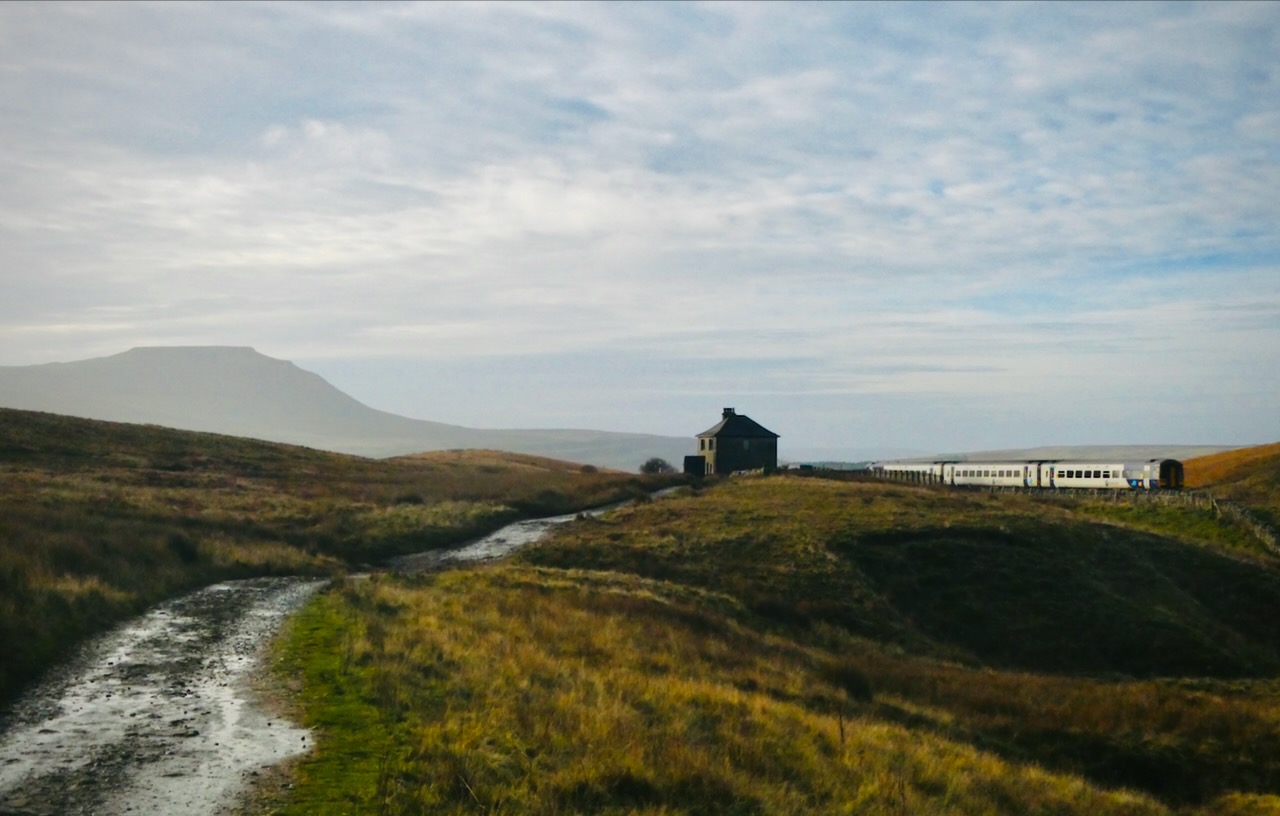
The 09:47 service from Ribblehead (ex Carlisle) to Leeds is more or less on time. This is the Settle-Carlisle railway, one of the country’s finest. In the background, Ingleborough, definitely the best-looking English mountain outside the Lake District — it’s 3,730 days (or 10 years, 2 months and 16 days) since it made its first appearance on here, on my 45th birthday day out (26/8/2014). And as it’s a good place to come for a day out, on the first appearance of sunshine for about two weeks — it was worth coming back.
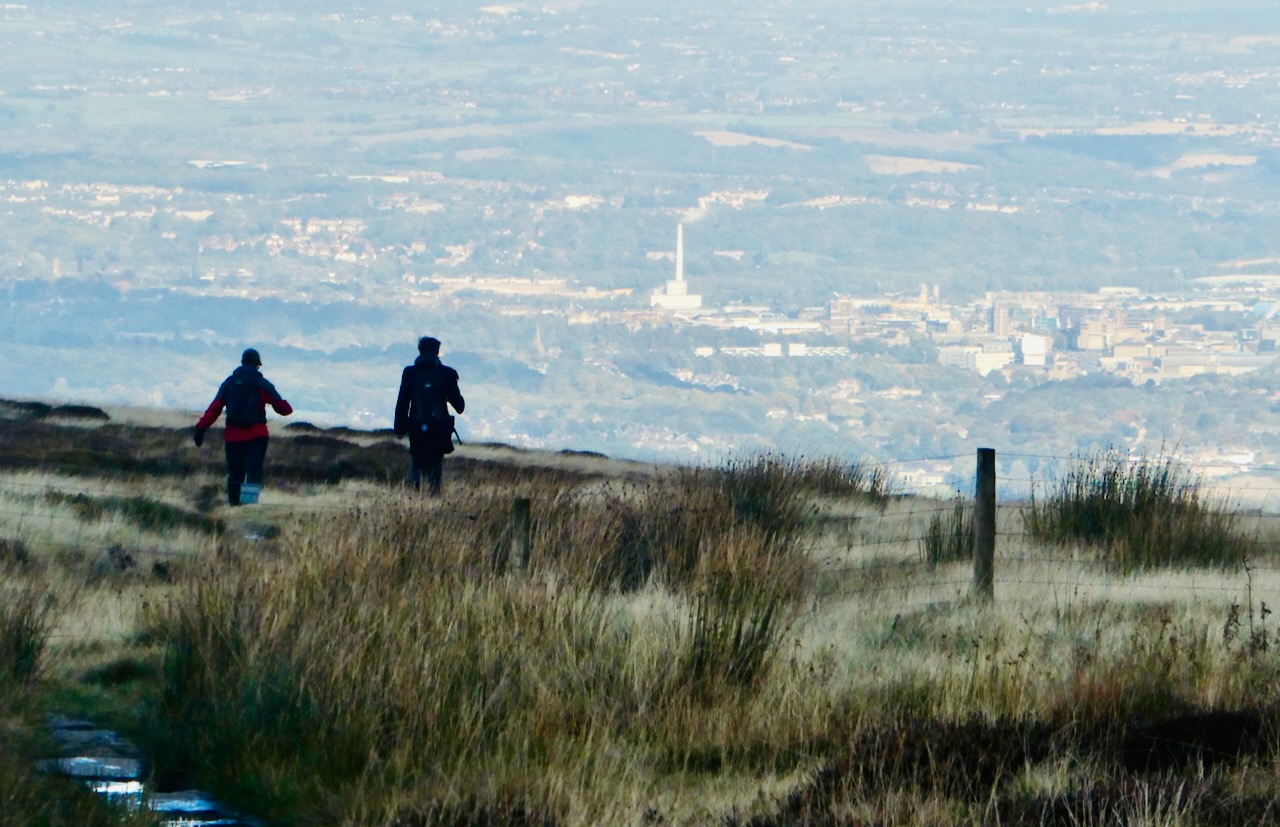
The Pennines are, definitely, the vertebrae of Britain (supporting the large, shaggy head that is Scotland). And today I, definitely, walked from one side of them to the other, starting a hike in Greenfield on the west and ending it in Marsden to the east: with the town seen in the background here being Huddersfield. Today, therefore, I definitely crossed England, in watershed terms anyway. The two guys seen here may or may not have done the same.
Can I note, though, that a lot of England’s spine is comprised of peaty, boggy shit. Get it cleaned up, England!
It’s been over a month since I categorised a post as ‘Landscape’, which may suggest I’ve not been getting out much, but I did find an excuse to hang out in Rochdale on this pleasant, bright evening. As might be obvious, this is taken with a very long zoom, and I like the way the shot suggests a random collection of objects kind of poking out of various bits of land (note the antenna skulking around at the very back hoping nobody notices it). The tower on the right is not that of a church, but of Rochdale’s magnificent Town Hall. What the red-and-blue arrangement to the left is — you tell me.
The area around Low Moor railway station, to the south of Bradford, is the most industrialised part of my local area. There’s plenty of photographic interest to be had within it, whether close-up or from more of a distance, like here. It’s nice that the windsock continues the diagonals of the cable and stairway, but its presence is somewhat ominous — and surely linked to the fact that Low Moor station is the only one I know where there are display boards warning of what to do if the alarms go off and the area needs to be evacuated. But it hasn’t happened…. yet.
I know this is grainy. But it’s been a long time since I made a point of seeing that kind of thing as a marker of quality. This shot will do as well as any other to epitomise my day, or at least, the part of it I spent hiking up near the Emley Moor TV mast, which is as good a Yorkshire landmark as anything. I seem to still be continuing the blog so on we go with its 14th year, and happy birthday to me too: you can do the sums.
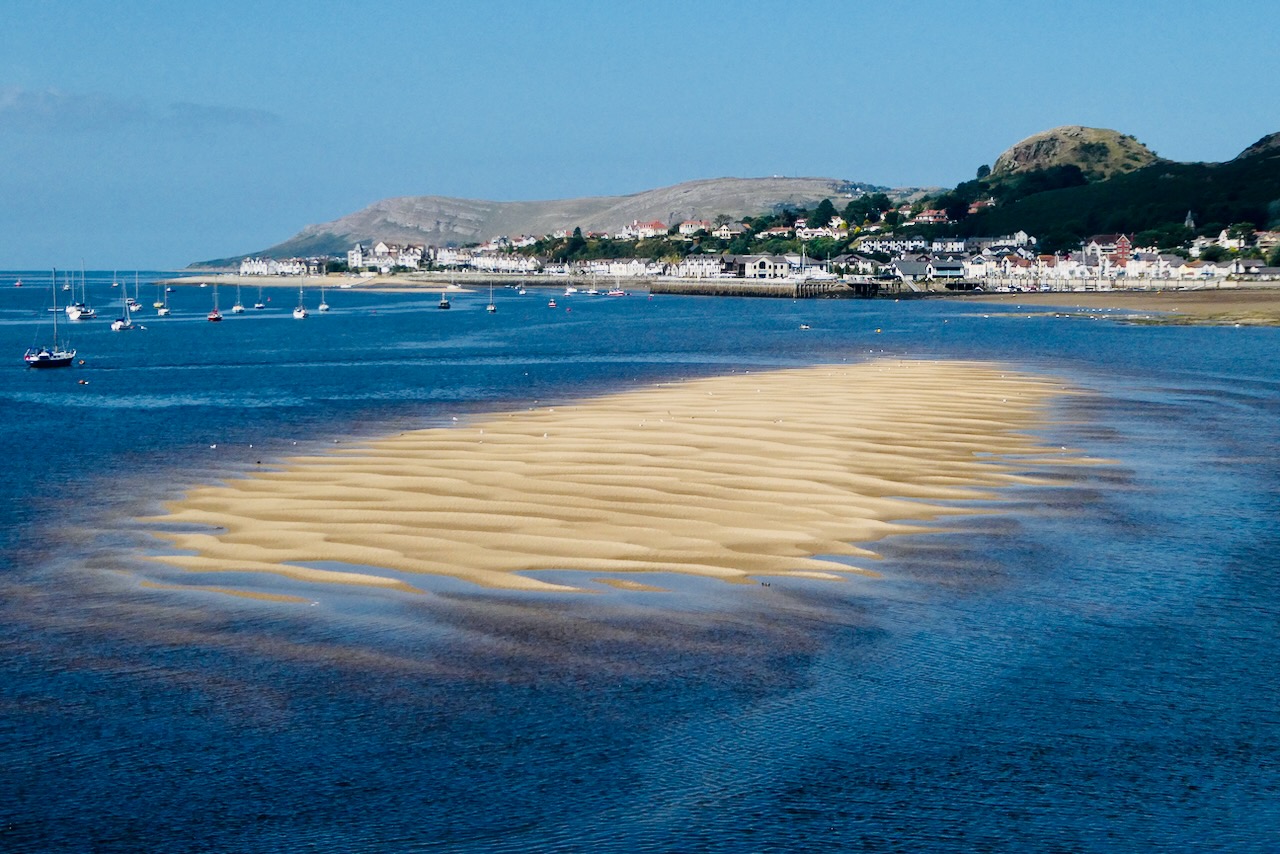
As no one really gives a toss whether I turn up at the office or not — particularly not in August — why not take the opportunity to get on a train, do a few hours’ work on the day, but still then take the afternoon off and spend it somewhere nice and sunny? The Conwy/Llandudno region is a fine-looking part of the world (as we discovered when we came here eight years ago). These kinds of regular Days Out are probably what it will take to keep me going for the rest of my life, spiritually — so let’s take the chances while they still come. And when the trains are working.
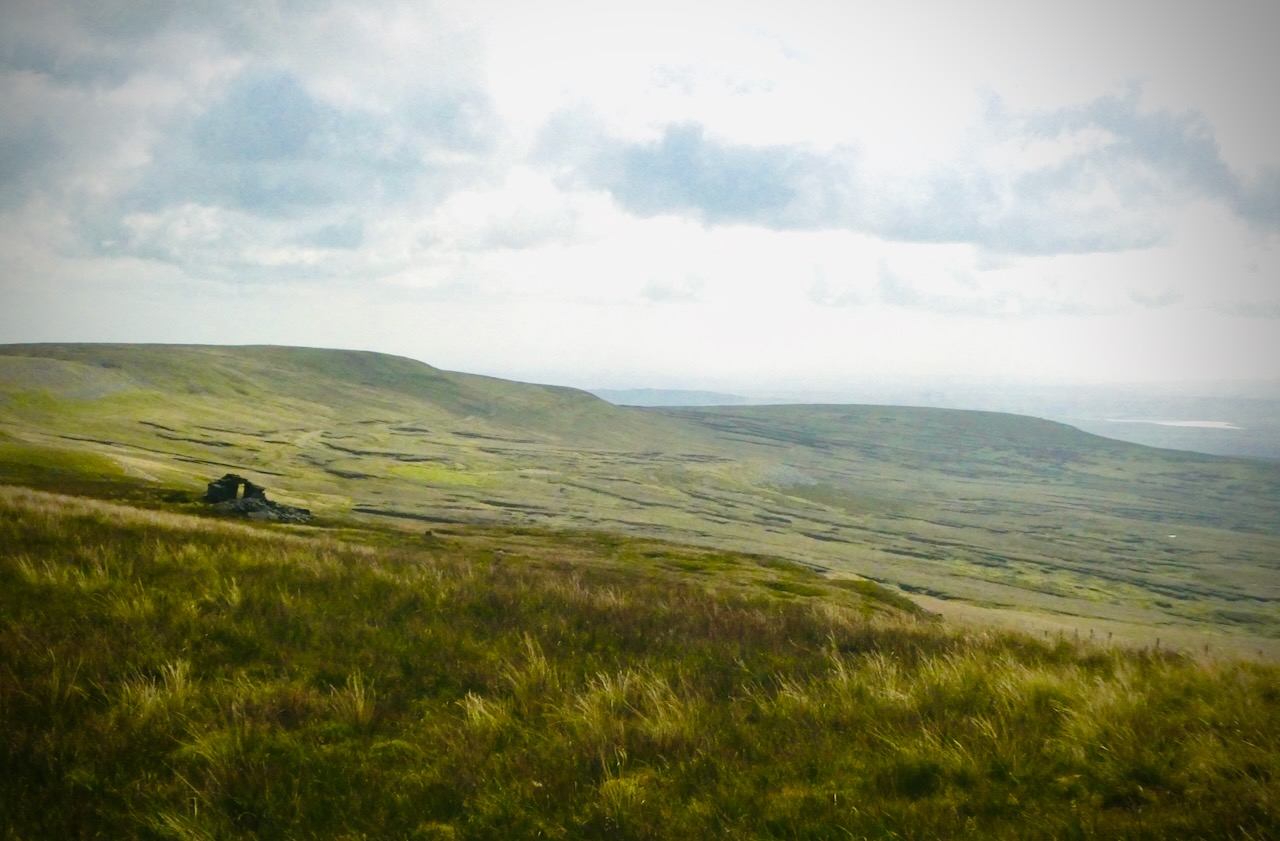
By British standards, Yorkshire has always been a big county. Chopped around with a bit since 1974, nevertheless, in terms of its historic boundaries it was the largest in the country. And Mickle Fell, at 2,585 feet/788m above sea level, was its highest point. Truly, therefore, between about 10.30 and 11.00 am, I was Top Yorkshireman — geographically, at least.
Of course, since 1974 this territory was allocated to County Durham instead — but let’s gloss over that little detail. If you want to find out more about my walk today, please do have a look at my other blog.
This blog has been going long enough (we approach 13 years next month), but my regular walks in the Lake District predate it: it was 19th July 2009 when the LD blog recorded ‘walk 1‘. Fifteen years have since passed, and with walk 215 today — I haven’t published the page just yet but will do so soon — I completed my bagging of every one of the 330 Wainwright fells therein: twice. Well, it’s certainly given me something to do (and to spend money on) in that time: but I am not upset it is finished, quite relieved, in fact. No broken legs, you know?
These guys stand at the top of Grains Gill, which runs into the heart of the District south from Borrowdale. I have just come off Great End, which would, toponymically, made a good finishing point but it turned out to be my penultimate fell — from here there is still Seathwaite Fell to come, just to the left of this shot.





 Being 42