The lump to top right is Ben More. Its Gaelic name literally means “Big Hill”, and it can join the ranks of places that have clearly been named for their physical characteristics. On the left of this shot, the start of the path up it, and it’s representative of the whole — a 3,000-foot climb, all like this. Imagine climbing one of the staircases up the Eiffel Tower, three times in succession. Do I do these things for fun? Yes, I suppose I do. (See also the other blog.)
At 3,156 feet/962m, Yr Elen — it may just mean Helen or Eleanor, or it might mean “The Leech”; you decide, that’s Welsh for you — is apparently the ninth-highest mountain in Wales. The last of five biggish lumps of rock that I negotiated today. More details on the other blog, as ever.
When I realised the weather forecast was going to stay much the same — that is, warm and sunny — throughout our visit to Scotland, a walk became by far the best choice for a Saturday activity. It wasn’t too hard to rearrange things accordingly, and I did not regret doing so. Below, the River Clyde, winding its way from Glasgow, over in the distance, to the sea, and crossed here by the Erskine Bridge. More photos and details of the day are on my County Tops blog.
The last time I posted a picture taken in Scotland was from the crossing of the Forth on 30th May last year. I crossed it again today, and nearly went for the same theme: whether one uses the road or the rail bridge, the views are invariably excellent. But this one isn’t bad, either, about half an hour further along the journey towards Dundee — and towards sunset. I think this was taken from somewhere near Markinch station; somewhere in Fife, anyway. What’s the building? No idea.
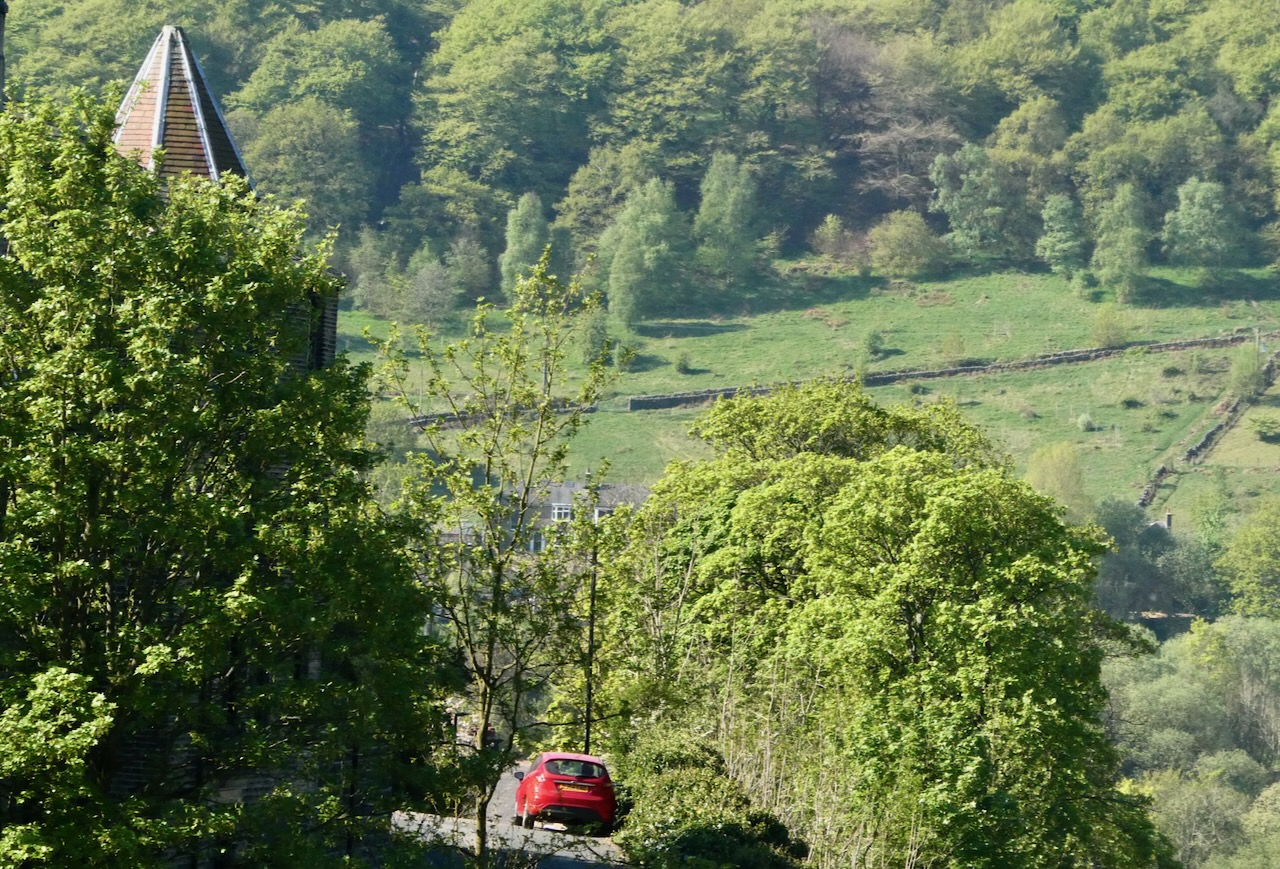
Or should it be, the parked red car? I know there is supposed to be some kind of innate order to English adjectives, but here I am unsure. Anyway it is often seen in this position — this was not a lucky capture. And yes, it tilts to a noticeable degree: otherwise, this shot is faithful enough to the perpendicular.
The Thames breaks up into a number of channels as it flows through Oxford. This one isn’t marked on the map as the main river, but the water, flowing in the direction seen ahead, will be back there, and heading down to London, fairly soon. An unscheduled morning here, but I am home now.
Seems an appropriate shot to mark my last day here. Though, I suppose, this is a descent rather than an ascent, but never mind. Mostly, this has been an enjoyable and interesting visit, but I feel it unlikely I will ever return here.
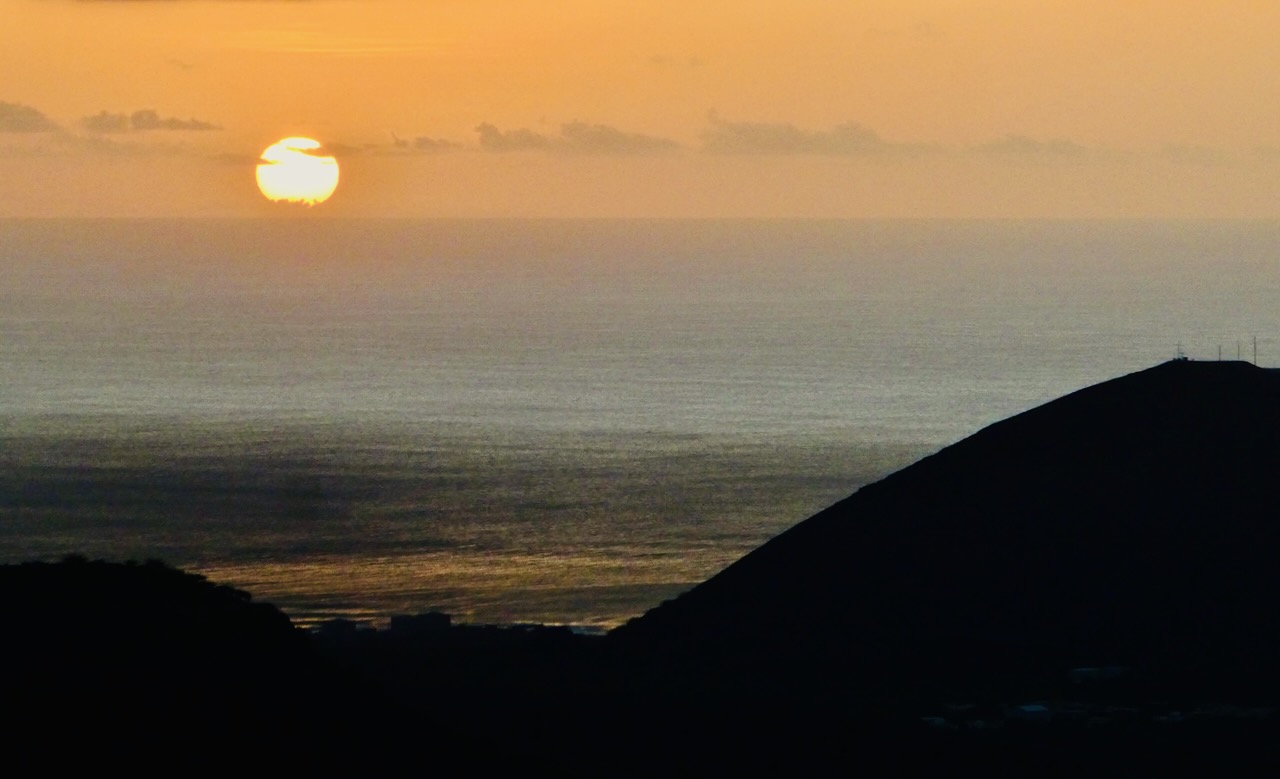
On April 11th last year I departed on my trip to Namibia, and tonight I should have been in the air again, but instead am sitting out the year’s latest flight delay and am scheduled to depart tomorrow instead. But there are worse places to be stuck, I suppose. The surf was certainly up today, one reason why none of Ascension’s glorious beaches are considered safe places to swim. In the foreground, one of the historic ‘Turtle Ponds’, thankfully no longer used — behind, Sisters’ Peak makes its second appearance.
Ascension Island is greener than I expected, although this is mainly due to the spread of an invasive weed, Mexican thorn, which authorities are trying to control (with some recent success it seems). But the peak in the centre of the island has long been known as Green Mountain for good reason. It was on this mountain that, in the 19th century, botanist Joseph Hooker embarked on a giant horticultural project to plant a forest and bring more rain to the island — and the jungle in the foreground of this shot is evidence that he succeeded. In fact, as far as I can tell this view is shrouded in cloud most of the time — some more is just visible drifting in from the right, but I nabbed the shot in a rare clear spell on my Sunday morning walk up to the island’s summit. Note also the Perfect Crater — that’s its official name — visible to the right of the cone of Sisters’ Peak.
Now that’s a change of scene: from thatched cottages to a desert island. It’s nearly a year since my research funding award and, consequently, my chance to visit Ascension Island, were confirmed, and 73 days since I uploaded the map of this place to the blog. Zoom into that image and look at the westernmost headland of the island, where you can just about see the label ‘Tanks’: those are what you see in the distance.
St Helena doesn’t have beaches, and the tourist industry of that island may well lament this fact. But Dead Man’s Beach is a stupendous swathe of sand, and right by the main settlement, Georgetown. What a marvellously evocative name it has (though it will be explained not by the shipwreck of some 17th century pirate vessel, but because Georgetown’s cemetery lies right behind it). This is not even to mention the turtles, evidence for whom lies everywhere: but they will, hopefully, be pictured on one of the remaining eight evenings that I am scheduled to spend in the middle of the Atlantic.