Only in Britain do we really try to create seaside resorts on north-facing coasts at latitudes like 56º above the equator: but Redcar, near Middlesbrough, just about gets away with it thanks to having a really excellent beach that stretches for miles. Even when the sun is out, though, you still need to be quite hardy to make a day of it, but obviously this family have the necessary genetic qualities.
On April 11th last year I departed on my trip to Namibia, and tonight I should have been in the air again, but instead am sitting out the year’s latest flight delay and am scheduled to depart tomorrow instead. But there are worse places to be stuck, I suppose. The surf was certainly up today, one reason why none of Ascension’s glorious beaches are considered safe places to swim. In the foreground, one of the historic ‘Turtle Ponds’, thankfully no longer used — behind, Sisters’ Peak makes its second appearance.
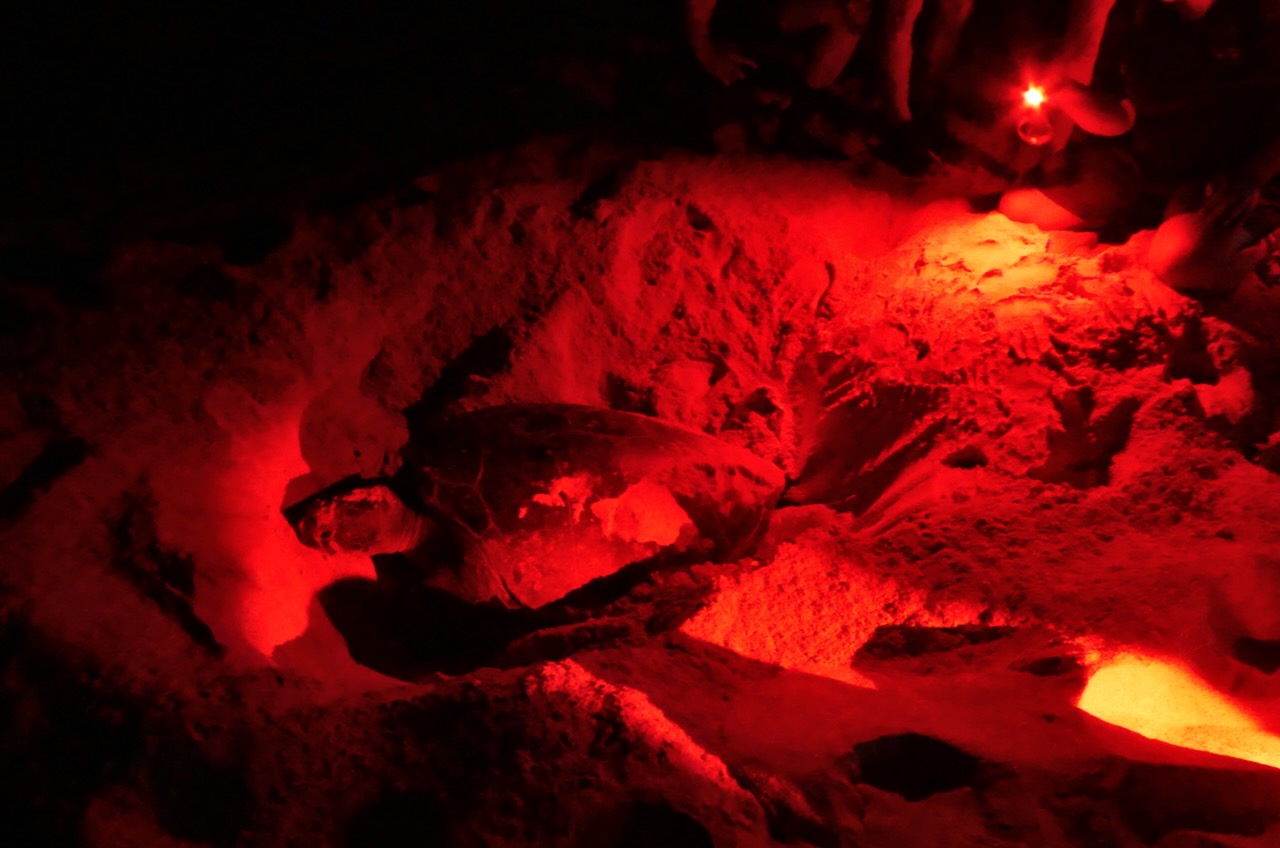
A true natural wonder of the world, the beaches of Ascension support a large population of green sea turtles, Chelonia mydas (though they don’t look green: the descriptor refers to the colour of their fat, not their shells). In the first half of the year hundreds come ashore nightly, dig pits in the sand and deposit dozens of eggs. Some time later, tiny hatchlings emerge and scurry back to the water: a few will survive to maturity and so the cycle begins again. Humanity seems to have learned to look after them slightly better than in the past. What you see here is a female actually laying: it is only during this time that they can be approached without scaring them, as they concentrate far too hard on pushing out the eggs to be bothered about surrounding humans on the Monday night ‘Turtle Tours’ organised by the Ascension Conservation Centre. One of the more worthwhile £10s I have ever spent. Red torches only are allowed.
Now that’s a change of scene: from thatched cottages to a desert island. It’s nearly a year since my research funding award and, consequently, my chance to visit Ascension Island, were confirmed, and 73 days since I uploaded the map of this place to the blog. Zoom into that image and look at the westernmost headland of the island, where you can just about see the label ‘Tanks’: those are what you see in the distance.
St Helena doesn’t have beaches, and the tourist industry of that island may well lament this fact. But Dead Man’s Beach is a stupendous swathe of sand, and right by the main settlement, Georgetown. What a marvellously evocative name it has (though it will be explained not by the shipwreck of some 17th century pirate vessel, but because Georgetown’s cemetery lies right behind it). This is not even to mention the turtles, evidence for whom lies everywhere: but they will, hopefully, be pictured on one of the remaining eight evenings that I am scheduled to spend in the middle of the Atlantic.
In 1960 the population of Dubai was 40,000. As of today it is more than 3.7 million, and continuing to rise at around 5% a year (all figures from Wikipedia). In order to accommodate them, the city is also growing physically. What you see here is not ‘desert’, it is large amounts of sand that have been poured into the Persian Gulf — land ‘reclaimed’ because the sea is not a form of terrain that can be bought and sold. Go to Google Maps and search for “Dubai Island Villas”; you’ll find it just offshore from the Al Hamriya Port, and you’re looking at a photograph of it, as of 24th February 2025.
Captured, perhaps obviously, a minute or so after take-off from DXB this afternoon. I was sat right over a wing again and only got this because of the plane’s considerable roll to the right for a few moments, so this was the last I saw of anything except clouds for the next seven hours. That’s the end of this trip, then, but it seems reasonably likely I will be back in Dubai at some point over the next 2-3 years. It will be interesting (but perhaps also a little depressing) to see what this view might look like in 2028, say.
The southern coast of the Isle of Wight is one of the best places in the world to find fossils. This is not, I now realise, because more creatures somehow died here in the past. In fact it is because the entirety of this coast is sliding, fairly rapidly, into the English Channel, and so things long buried are regularly uncovered. Look at the erosion here — and the obvious geology, sandstone on the left, chalk thereafter. If you want my considered opinion I wouldn’t buy property too near this coast.
I have yet to start bringing my own deckchairs to beaches, and Clare and I remain, hopefully, more active than this — we reached Shanklin beach today, on the east coast of the Isle of Wight, after a 7.75 mile walk that you can read more about on my other blog. But in spirit, here we are. Give us ten years — maybe fifteen — and our bodies may be here too.
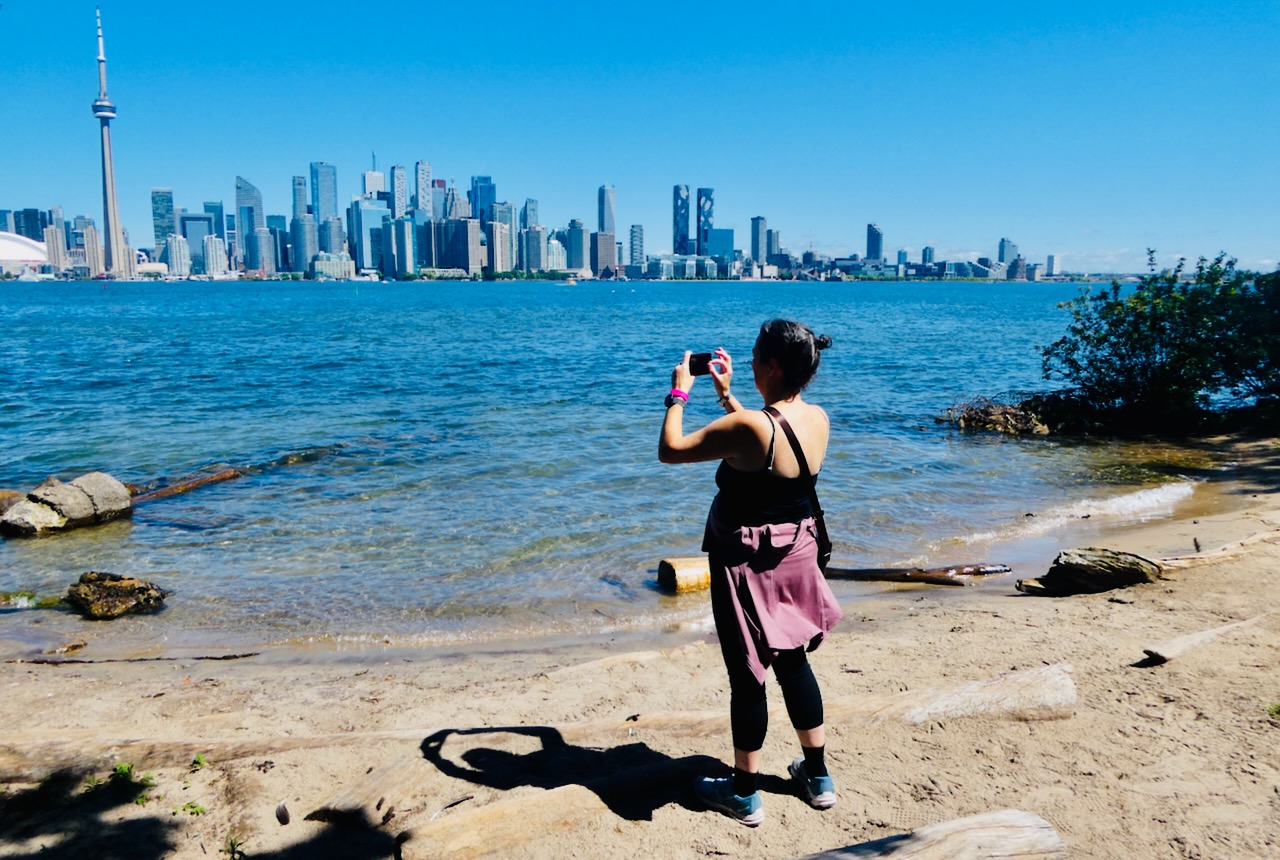
Clare has flown out to Toronto to join me for a few days, and why not, it’s a fine city to explore and also to look at. The skyline seems very well balanced and the CN Tower sets it off excellently. The best view of it is from the islands just offshore in the Lake, which is why a lot of people go there on a nice day — though she made it before the weekend. I like the shape her shadow makes on this one.
I was forewarned about the fogs that affect the coast of Namibia. The Benguela current sweeps cold water up from Antarctica, and as it passes the African coast it mixes with the warm air coming off the continent. But just because I understand the climatology doesn’t mean that the actual experience of the fog hasn’t come as a surprise because they really are bloody cold; the mornings and evenings here in Swakopmund have not at all been like one might imagine an African beach holiday, more like Morecambe in November. These two swimmers must be seriously hardy.
The Midland’s second appearance on the blog, after this shot, 2,627 days ago– which is less vivid, and I prefer this one. It’s nice that we’re getting some sunshine, which in the last few weeks of 2023, was at a premium.






 Being 42