More desert, this time from above, the second of my internal Namibian flights, to Swakopmund on the coast (of which more tomorrow). The shapes here are just amazing, like the earth itself is crinkled, akin to the skin of a passion fruit, say. Quite probably, no one ever sets foot here from one century to the next.
Sossusvlei is one of Namibia’s major tourist attractions and probably you have seen pictures of it before — sinuous, ruddy, massive sand dunes pictured at dawn etc. etc. And I did get such shots today. But I’ll go with this one. Dead Vlei (a ‘vlei’ is the Afrikaans word for a marsh or riverbed without open water in it) was once connected to Sossusvlei but a few hundred years ago, shifting sand dunes cut it off and since then it has dessicated to a hard clay pan with ancient, dead trees still left from that time.
What is behind them, and the seated woman, is not grey sky but a massive wall of sand: the dune known as ‘Big Daddy’, which is nearly 1,000 feet (324m) high. The Namibian tourist board would like you to believe it’s the world’s biggest but I checked it out and it’s not even close to the winner, which is a dune in Argentina that’s a staggering 4,000 feet high: Big Daddy is in the top 10, though. A marvellous and highly photogenic place, even if I did have to get up at 5.30 to reach it.
This was a day on which I could have posted any one of several pictures, including many with cute fauna. Today I captured shots of ostrich, oryx, wildebeest, zebra (the most unexpected), and springbok. But this one makes it because of its nicely unexpected nature. On the flight from Windhoek to the airstrip at Geluk we passed over increasingly barren and arid landscapes, yet still, here and there, there were dwellings, astonishingly remote. A few minutes before we landed I caught sight of this place, nestled in the shade of the rock, for all the world like a Fremen sietch, sheltering from the sandworms on relatively solid ground (a reference from Dune: if you don’t know this great novel by now, then shame on you, and yes, the movies are decent too).
Then, about 90 minutes later, I discovered that this was my hotel for the next two nights. Right now I type this in the leftmost of the line of huts to the right: the two buildings at the end of the gravel road being the restaurant, reception and staff accommodation of the Namib Outpost Lodge. I’ve certainly never had the privilege of staying anywhere else like this in my life.
Tried to resist the temptation to put up another shot taken while flying over Namibia, and failed. The Namib Desert is apparently the world’s oldest, and runs straight down to the sea, making it look like a gargantuan beach, stretching hundreds of miles in every direction. You wouldn’t want to come here for a holiday however. No water anywhere, and combined with thick sea fogs and strong currents which can make it impossible to launch again, this is probably the most dangerous coast in the world for seafarers. Little wonder it has been termed the ‘Skeleton Coast’. Personally I think it appears as Mars might. Perhaps contrarily (but I’m like that), I find myself now quite wanting to visit this country properly. Maybe next year.
Random African country, 2/2, although unlike Ethiopia, this one — Namibia — was on the original schedule. Walvis Bay is where the Johannesburg to St Helena flight stops to refuel. On the approach, over miles of utterly barren desert, it is inconceivable that there could, or should, be a town of over 60,000 people here, but it seems that Walvis Bay is the one natural harbour for hundreds of miles in either direction, and so is the principal port for the whole country, not to mention handling traffic for landlocked Botswana and Zimbabwe as well. What the construction visible on this shot is, I have no idea for sure, but it might be the top of an artesian well, as almost all the water supply for the town comes from underground.
That’s it for my 3-day perambulation around two continents, and six airports (Manchester, Geneva, Addis Ababa, Johannesburg, Walvis Bay and St Helena). Two weeks on St Helena will now follow.
The flight home. The Sahara looked astonishing: this was a day when I wish I could break my own rules and post more than one photo. The River Niger certainly was worth seeing, a braid of blue and green running through a sandy wasteland. We must have crossed that somewhere in Mali.
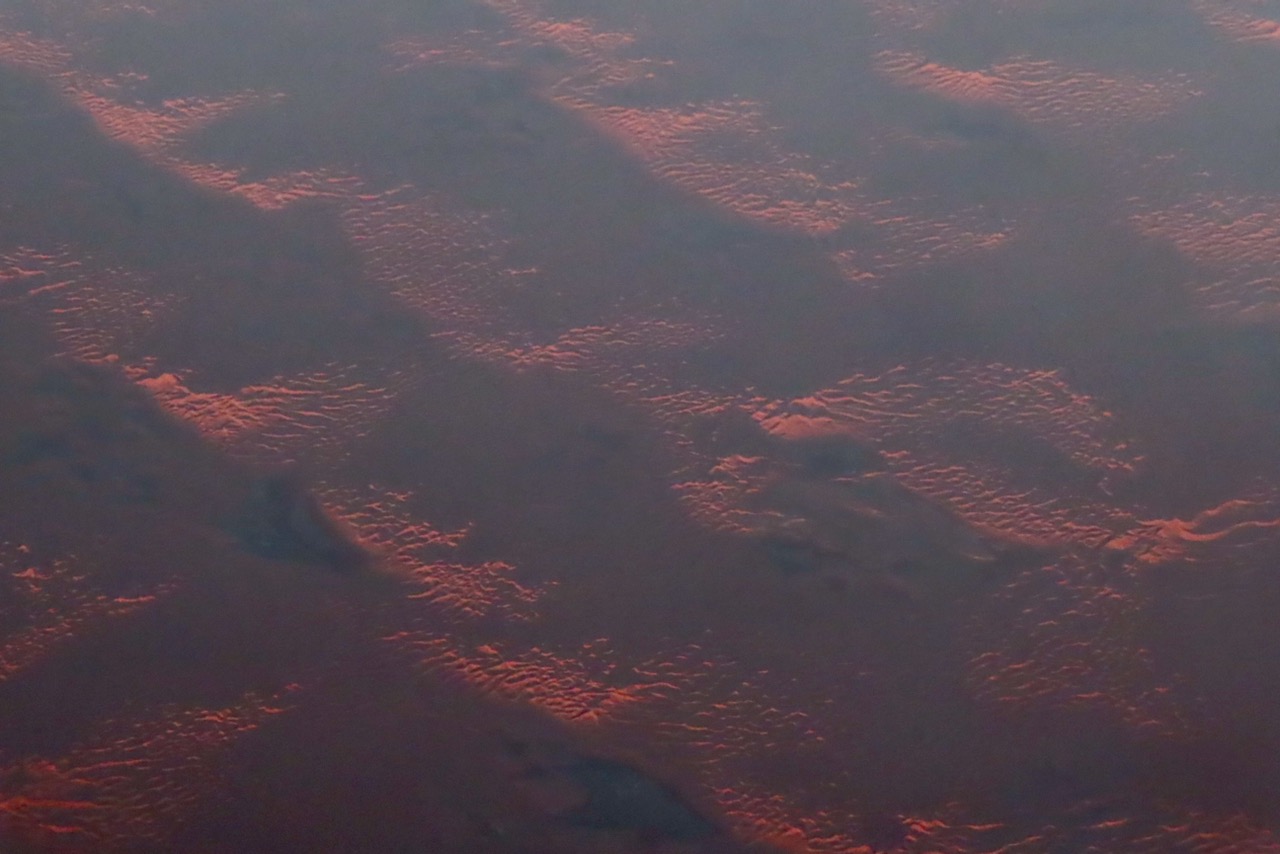
But instead I will go with this shot; for much of the three hours it took to cross the desert I was thinking, hmmm, well it’s certainly barren, but more rocky than sandy. But then came this sea, this ocean of dunes, tinged by the setting sun. This must be far enough north to be somewhere in Algeria. Not that national boundaries really mean a lot here. If anything this is Arrakis. Had a gigantic sandworm crested out of this stuff with Fremen on its back, I would not have been surprised.
Friday 11th January 2013, 5.05pm [Eastern African Time] (day 505)
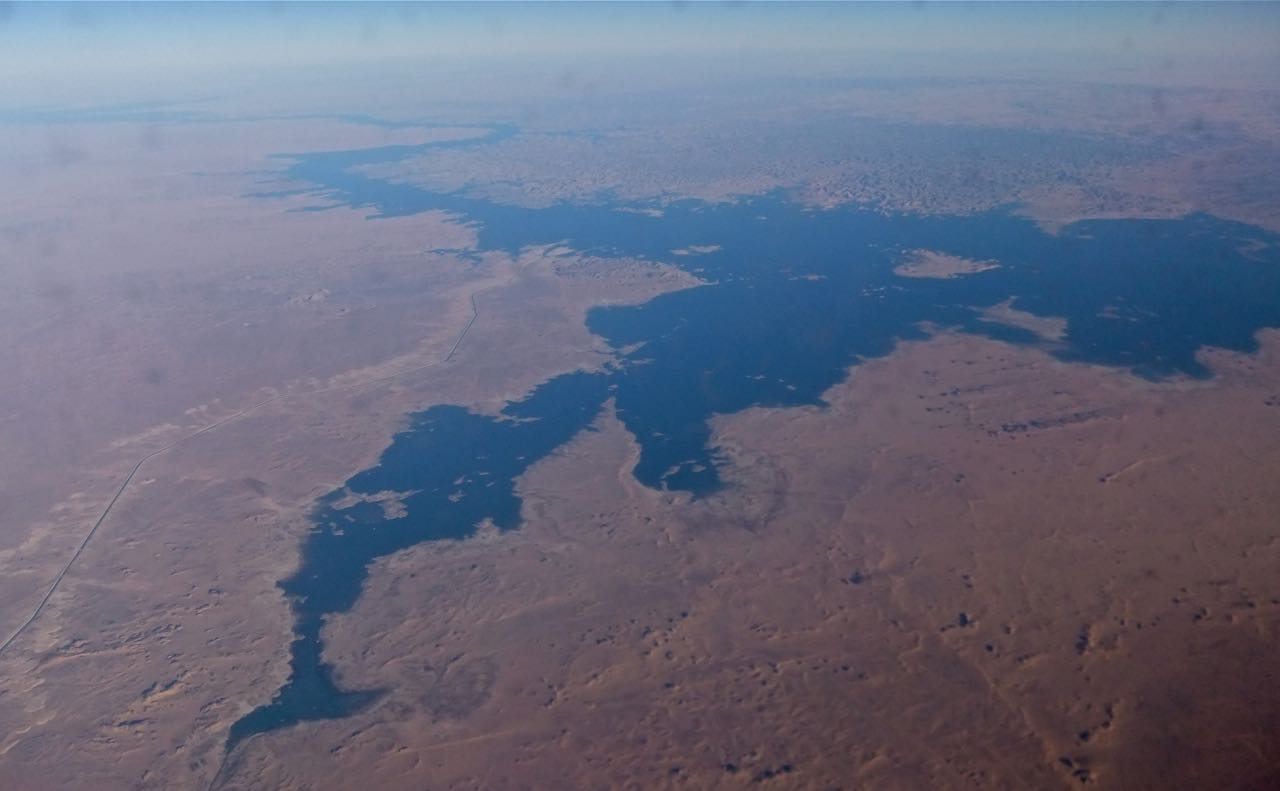
The idea of flying over the Sahara did appeal at first, but for much of it there was almost nothing to see – as one would expect, I suppose. Nothingness – at least, when seen from 35,000 feet – got boring rather quickly. However, flying over this huge expanse of water among the dunes did wake up the photographers amongst us for a while. Look closely enough at this shot and you can also get a sense of the curvature of the Earth: the horizon has a definite bend to it.


 Being 42