Clare really dislikes Apocalypse Now and I have given up trying to establish why this is. It’s not that she has anything against the genre, as she agrees Full Metal Jacket is a classic, for instance. But she was out all evening….
On the other hand, having sat through the Coppola Cut for the second time, unlike with some movies (particularly The Wicker Man which was butchered in the initial edit) this one doesn’t benefit all that much from the additional material. All it really adds is forty minutes and three pairs of breasts. Nevertheless if you ask me (but not Clare) this remains a work of crazed brilliance.
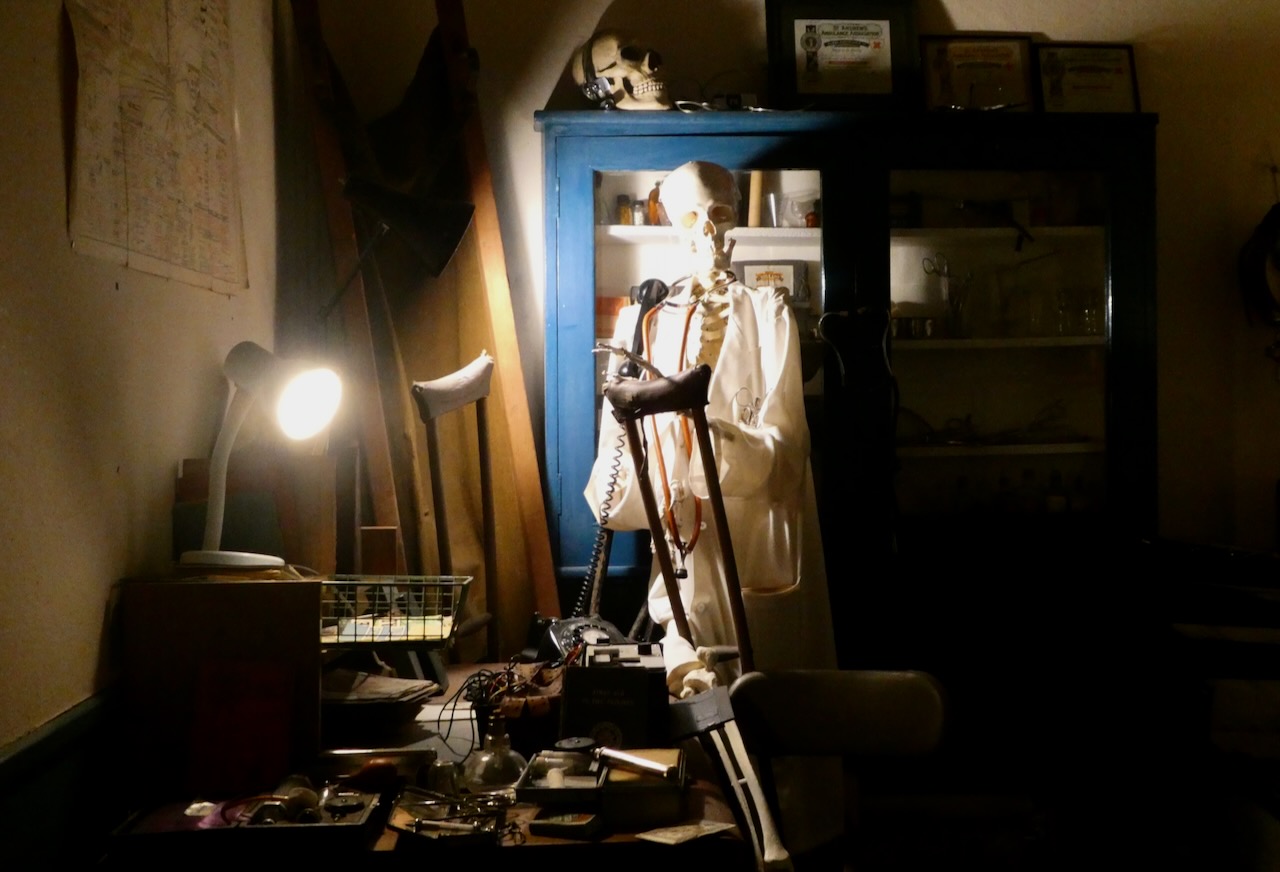
The tour of Scotland, or at least, the eastern-central part of that country, continued with a visit to “Scotland’s Secret Bunker“, which until 1992 or thereabouts was maintained as the home-to-be of government in Scotland were that country (and presumably the rest of the UK) ever to be taken out by a couple of dozen nuclear missiles. It says a lot for the managerial mindset that a significant amount of money was spent on building and maintaining this place, with its various dormitories, a broadcasting station, two cinemas, a canteen (still in use, for visitors), state-of-the-art air conditioning and fire protection and various Monitoring and War Rooms (“Gentlemen! You can’t fight in here, this is the War Room!”). Plus a clinic, as pictured here with its touches of black humour.
That this is now open to visitors, albeit privately owned and charging a healthy price (£50 for the three of us), is some consolation but begs a natural question — where’s the current version of this? Or versions, as there were long-standing and fairly plausible rumours that another one of these sat up on Ashdown Forest in Sussex, near Crowborough where I grew up. And how much do they cost in terms of, say, nurses’ or teachers’ salaries? The place was definitely worth a visit, if only to invoke such questions in Joe’s mind.
Yesterday’s sunset presaged a bright, sunny day, but I was inside for most of it. A brief foray out this morning did at least offer the opportunity to get my tribute in for the 100th anniversary of the armistice that ended World War 1. Four days late, but the poppies are still in formation.
Unlike the other Channel Islands, Alderney was completely evacuated in June 1940, eight days before the Germans arrived to occupy it for the next five years. Because of the lack of a civilian population, they pretty much did what they liked here, fortifying the island to an immense degree (to the extent that the Alderney garrison did not surrender until 16th May 1945, a whole week after VE Day). The labour that this required was undertaken mostly by Russian POWs, who were housed in four camps, or lager, each named after German North Sea islands. Lager Sylt was the camp for Jews, run by the SS, and along with nearby Lager Nordeney was thus the only concentration camp — so far — to have been built on British soil. 400 graves of prisoners have been identified on Alderney but many more are estimated to have died here. The only remaining sign of any of the camps are these old concrete gate posts, on the edge of the airport, and the small plaque affixed thereon, fading text declaring that this was the entrance to Lager Sylt.
World War 2 too often gets treated as some big nostalgia kick. But it’s worth remembering that all those years, all that effort and suffering and hardship, was fought for poor bastards like those prisoners, to stop this kind of thing ever happening again. As time passes and the ruins moulder away, there’s a risk that some people are forgetting this.
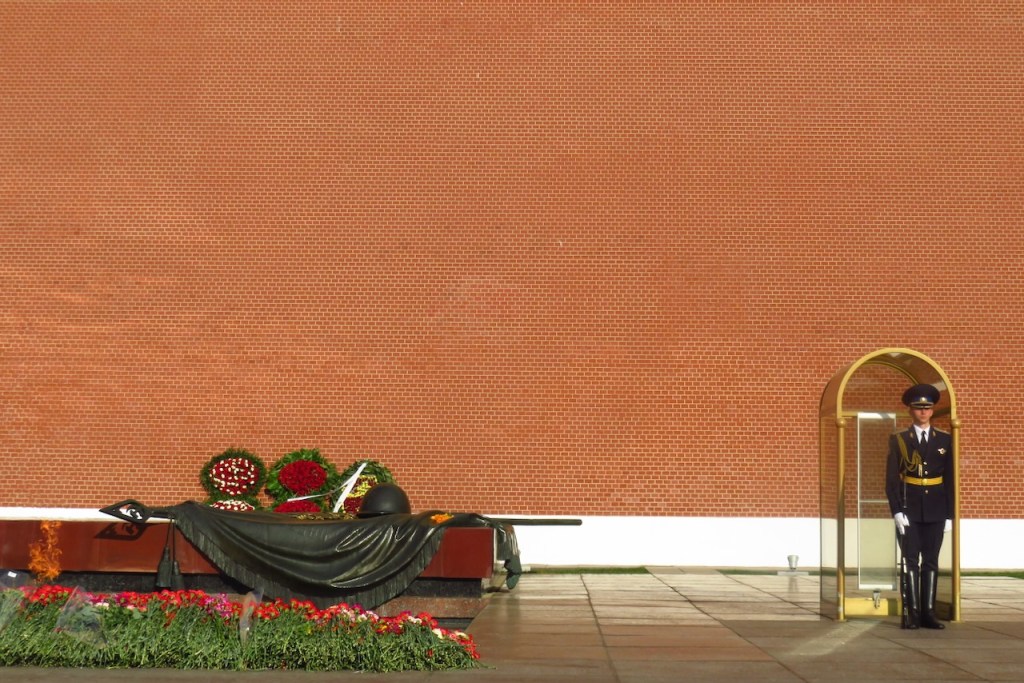
Seeing as I missed the Victory Day celebrations yesterday let’s pay homage with this shot. The Russian Tomb of the Unknown Soldier lies below the monumental west wall of the Kremlin, at one end of a row of memorials to various Soviet cities, all decorated since yesterday with garlands of flowers. I think we citizens of elsewhere mostly forget that it was the Soviets who lost the most men (and women) of all the countries who fought in World War Two. They have a right to remember the dead. Perhaps not to celebrate them — but to remember them.